
Most buyers frame this as a price question. It rarely is. A cheaper hire who cannot answer when you need them costs more than they save.
The better question is what the work needs from the clock. Some roles die when every answer takes a day. Others get better when someone works while you sleep. Get that right and the location choice mostly makes itself.
What is the difference between nearshore and offshore?
Nearshore means hiring in a country close to yours, in a similar time zone. For a US company that usually means Mexico, Colombia, Brazil or elsewhere in Latin America. Offshore means hiring further away, often in the Philippines, India, Eastern Europe or South Africa, with a larger time difference.
Both are remote hiring. The person works for you full time, uses your tools and joins your meetings where the hours allow. What changes is the overlap with your day, the size of the talent pool for a given skill, and how handoffs work.
Here is what 9:00 in New York looks like in a few common hiring locations, based on the IANA Time Zone Database that most software uses:
| Location | Local time when New York is at 9:00 (January) | Local time when New York is at 9:00 (July) |
|---|---|---|
| Mexico City | 8:00 | 7:00 |
| Bogotá | 9:00 | 8:00 |
| São Paulo | 11:00 | 10:00 |
| Warsaw | 15:00 | 15:00 |
| Johannesburg | 16:00 | 15:00 |
| Manila | 22:00 | 21:00 |
A Bogotá hire works the same hours as your New York office all year. A Manila hire starts their day as you end yours, 12 or 13 hours apart.
Nearshore vs offshore side by side
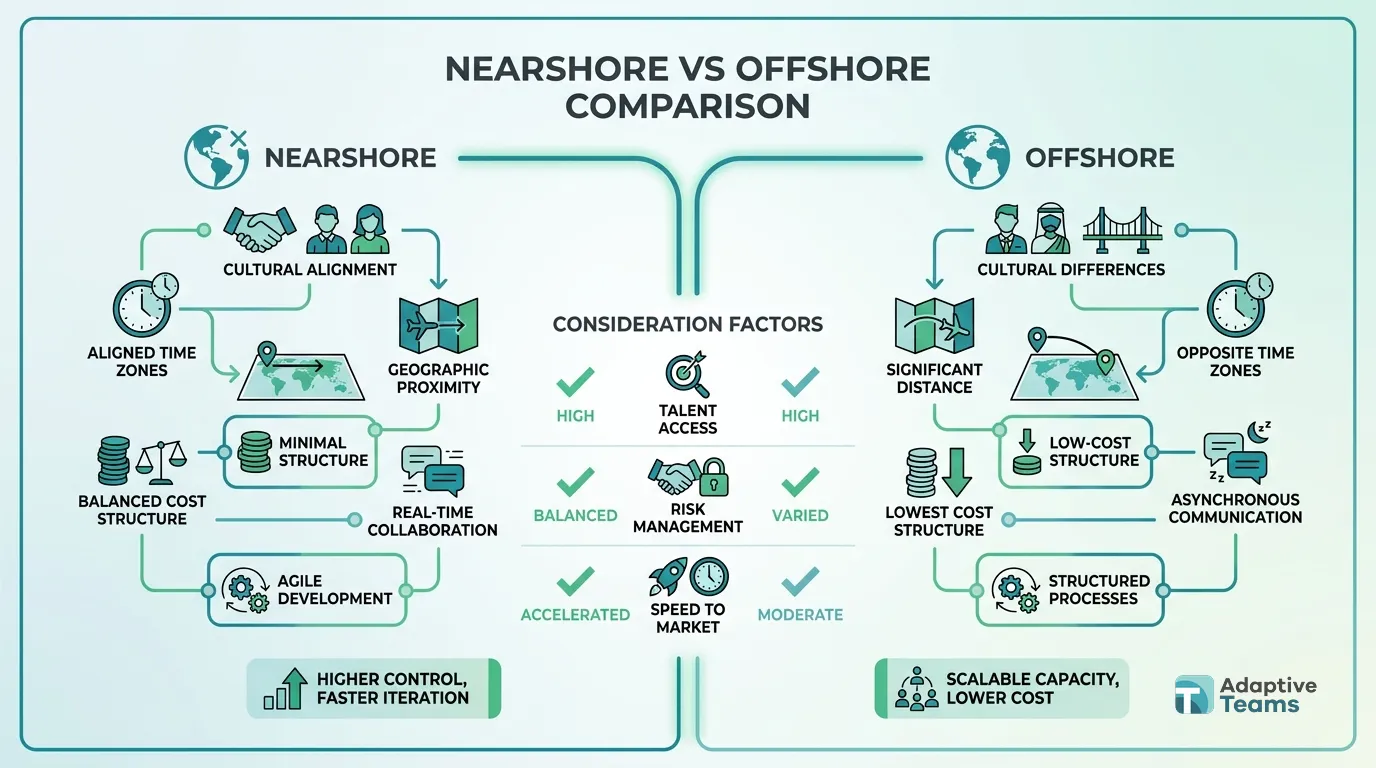
These are the points that decide cost and day-to-day friction for a full-time remote hire.
| Nearshore (Latin America) | Offshore (Asia, Africa, Eastern Europe) | |
|---|---|---|
| Overlap with a US workday | 6 to 8 hours | 0 to 3 hours from Asia, 2 to 4 from Europe and Africa |
| Best fit | Live sales, support, engineering in sprints, roles with many meetings | Back office, bookkeeping, overnight support, async engineering, content |
| Talent depth | Strong for Spanish and Portuguese, growing tech pool | Very deep pools for accounting, customer service and admin roles |
| Handoffs | Same-day questions and answers | Overnight handoff: work is ready when you log on |
| Travel for onboarding | Short flights from most US cities | Long-haul, rarely needed |
| Typical cost with Adaptive Teams | Most engagements start at $2,500 a month all-in | Same starting point; senior roles cost more in any region |
The cost row surprises people. Pay varies by country, but for most roles we fill, the all-in monthly rate is driven more by seniority and skill than by the map. Our guide on what an offshore development team actually costs breaks this down by role.
When is nearshore the better choice?
Nearshore wins when the role needs live conversation many times a day. Think of an SDR who joins your pipeline calls, a support lead who escalates to your product team, or a developer in a two-week sprint who needs answers before lunch.
A 6 to 8 hour overlap means those questions get answered in minutes. It also means the new hire sits in your standups, hears context in passing and picks up how your company talks. For a first remote hire, that shared day makes onboarding easier.
Where nearshore gets harder
The pool is smaller for some back-office skills, and demand from US companies is high. Strong bilingual engineers in Mexico and Colombia get several offers at once. Expect to move quickly on a good candidate and to pay closer to the top of the local range.
When is offshore the better choice?
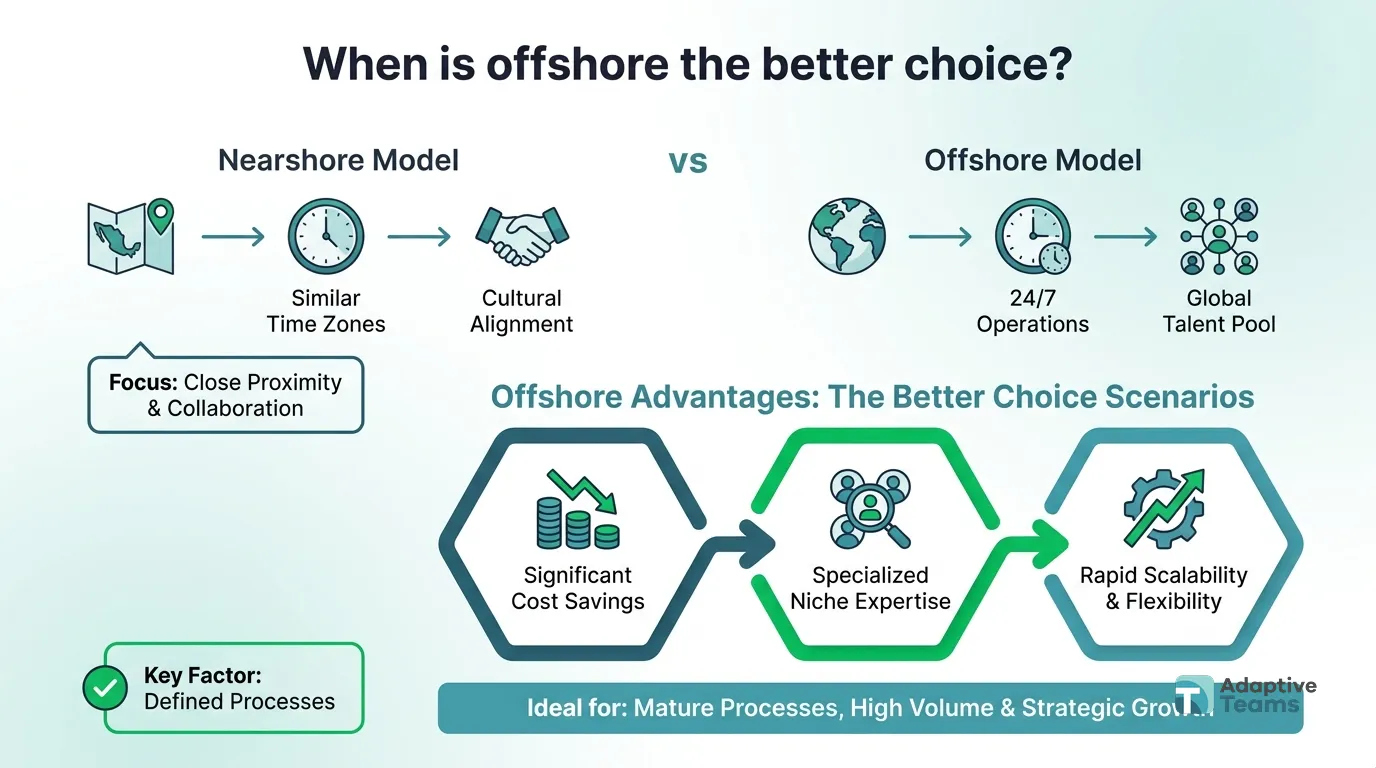
Offshore wins when the work runs on handoffs or needs hours your team cannot cover. Bookkeeping, reconciliations, ticket queues overnight, data entry, content production and QA all fit a model where you leave instructions at 18:00 and review finished work at 9:00.
The talent pools are also deep. Our own recruiting system shows how many people apply for remote roles: across 954 roles posted since September 2024, marketing roles alone drew 13,506 applications, according to our hiring insights. That volume lets us be strict when we screen.
Making a 12-hour gap work
The gap is manageable with a few habits. Write tasks down in full, agree on a 1 to 2 hour overlap window for live questions, and give the hire authority to decide small things without waiting a day. We cover the detail in our piece on time zone management for remote teams.
Where it fails is a role that secretly depends on live access. If you find yourself scheduling 7:00 calls every day, the role belonged nearshore.
Find Out Which Region Fits Your Next Hire
Tell us the role and your team’s hours, and we will send a staffing plan with the region, cost and timeline.
Book a Free ConsultationHow much does each model cost?
The honest answer is that the region matters less than most price tables suggest. Local salary levels differ, but a senior engineer is expensive everywhere, and a solid bookkeeper costs a fair wage in any market we recruit in.
What stays the same is the cost of hiring badly. According to SHRM benchmarking data, the average cost per hire in the US was nearly $4,700, and employers estimate the full cost at three to four times the position’s salary. A cheap hire in the wrong region repeats that cost.
With Adaptive Teams the structure is simple in both models. There is no placement fee, most engagements start at $2,500 a month all-in, and you stay month to month. Every placement carries a free replacement guarantee.
Mixing both: the model many teams end up with
A blend often works best. Customer-facing roles sit nearshore, and the back office runs offshore. That gives you live coverage during US hours and finished work waiting each morning.
KO Storage is a good example. They came to us for four call center agents. Eighteen months later they had 70+ team members across six departments, from call center to accounting and IT.
The wider market is moving the same way. Deloitte’s Global Outsourcing Survey 2024, based on more than 500 executives, describes companies combining outsourcing, in-house centers and other sourcing models instead of relying on one.
If you are weighing providers for either model, our list of the best offshore staffing companies shows what to check before you sign.
How we decide the region for a role
Before we source, we ask four questions about the role:
- How many hours a day does this person need to talk live with your team?
- Does the work arrive in batches that can be handed off overnight?
- Which language, accounting standard or software does the role require?
- What is the budget for this seniority level?
The answers usually point to one region. When they do not, we source in both and let the shortlist decide. Our recruitment services source across Latin America, Europe, Asia and Africa, from 30+ countries, and you see 3 to 5 screened candidates before you interview anyone.
Our team members live in 12+ countries, and hires are employed through an employer-of-record partner that covers 150+ countries. You need no local entity in either model.
Where to start
Write down the role, the hours it needs live, and the tasks that could wait overnight. That short list tells you more than any cost table. Then book a call and we will map it to a region, a shortlist and a start date, usually 2 to 3 weeks out.
Frequently Asked Questions
Is nearshore more expensive than offshore?
Often slightly, for the same role, because Latin American pay levels for tech roles have risen with US demand. The difference shrinks once you count seniority, turnover and management time. With Adaptive Teams, most engagements in either region start at $2,500 a month all-in, with no placement fee and month-to-month terms.
Which countries count as nearshore for US companies?
Mexico, Colombia, Brazil, Argentina, Costa Rica and other Latin American countries are the usual nearshore options. They sit within a few hours of US time zones. Bogotá matches New York hours all year, and Mexico City runs one or two hours behind New York depending on the season.
Can an offshore team work US business hours?
Yes, some offshore hires work night shifts to match US hours, which is common for customer support. It works best when the role pays for it and the person chooses it. For most offshore roles, a 1 to 2 hour overlap window plus written handoffs is more sustainable for everyone.
How long does it take to hire a nearshore or offshore employee?
With Adaptive Teams, most roles are filled in 2 to 3 weeks in either region. We scope the role, source candidates, test skills and English, and bring you a shortlist of 3 to 5 people. The traditional US hiring process often takes 3 to 6 months for a single role.
Ready to Build Your Dream Team?
Book a free staffing consultation with our remote team specialists. No obligations, just actionable insights for scaling your operations.
Book a Free ConsultationWant more of this in your Google results? Add Adaptive Teams as a preferred source.
 Adaptive Teams Editorial TeamRemote hiring, HR and payroll