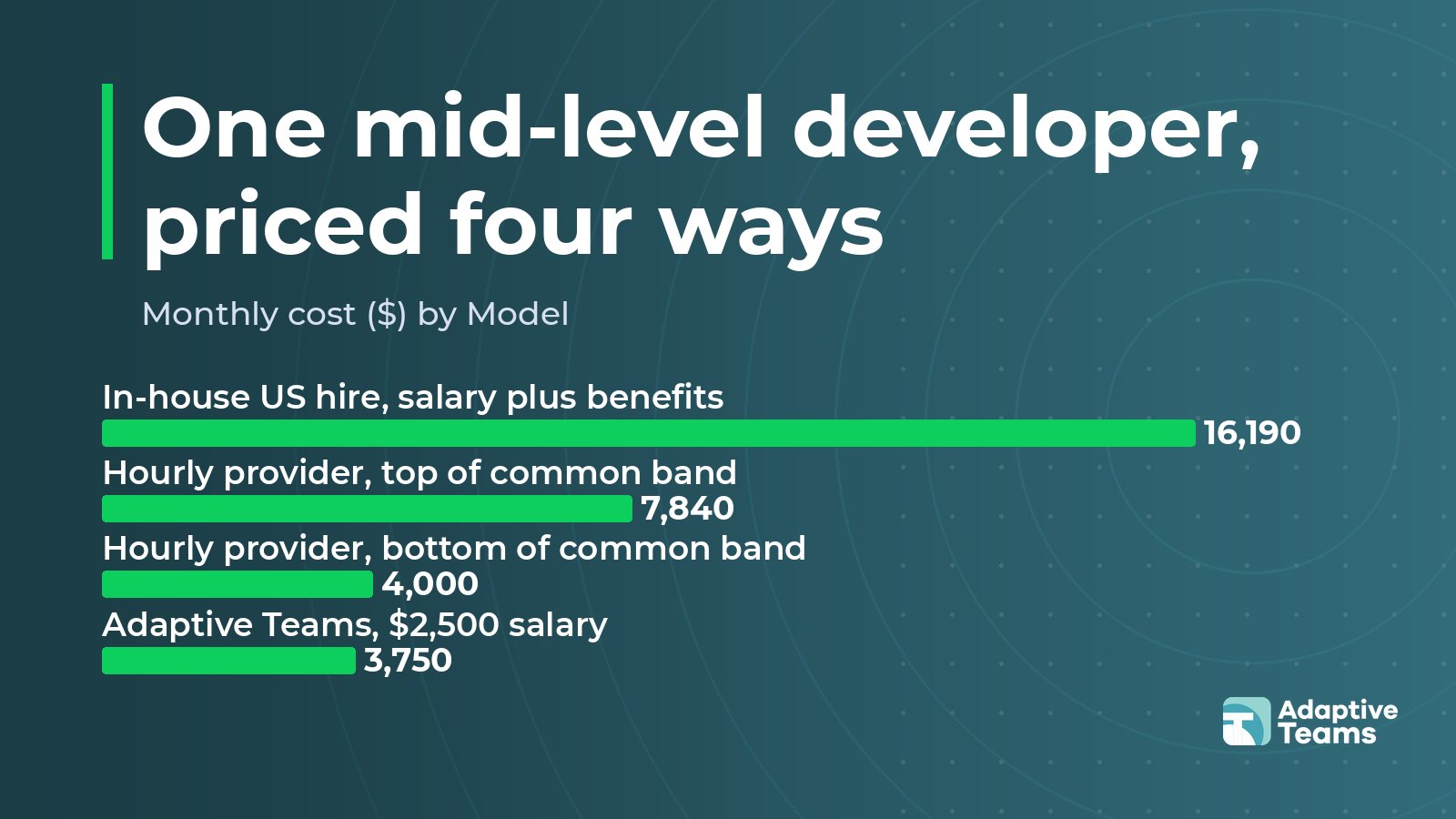
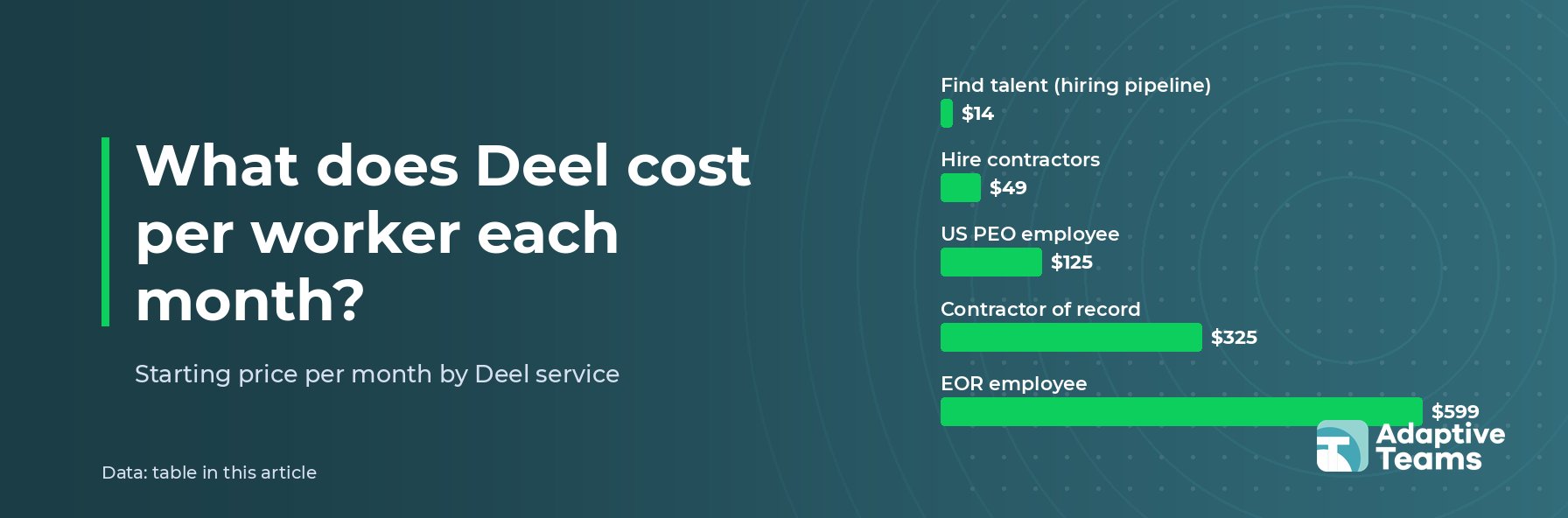
TL;DR
Deel alternatives fall into four groups: another EOR or payroll platform, a contractor payment tool, your own local entity, or a managed staffing partner. Platforms only employ and pay the person you already found. If you also need someone to recruit, onboard and manage that hire, a staffing partner fits better. Adaptive Teams is one, and it runs contracts and payroll on Deel itself.
Most people searching for an alternative to Deel are not unhappy with payroll. They signed up to hire one person abroad, and then found out the platform expects them to bring that person. Sourcing, interviews, onboarding and the monthly check-ins stay on their desk.
That is the real fork in the road. Either you want the same thing Deel sells at a different price, or you want a different job done altogether. This page sorts the options by that question first and by price second.
We have a stake in the answer. We are Adaptive Teams, a remote staffing agency for US companies and one of the options compared here, and we wrote this page. Our own contracts and payroll run on Deel. That does not make the platform a bad choice. A platform covers one part of the job, and this page shows which part.
Deel alternatives side by side
The table compares the four models on the points that decide cost and workload for a long-term hire.
| EOR or payroll platform (Deel, Remote, Oyster) | Contractor payment tool | Your own local entity | Managed staffing partner (Adaptive Teams) | |
|---|---|---|---|---|
| What you buy | Legal employment or contractor payments for a person you found | Invoicing and payouts to contractors | A company of your own in the hire's country | A hire recruited, employed and managed for you |
| Who finds the person | You | You | You | We do: a shortlist of 3 to 5 screened candidates |
| Who runs HR and reviews | You | You | You, with local advisers | Our team, with a dedicated manager |
| How you pay | Fixed fee per worker per month | Fee per contractor or per payment | Setup, accounting and legal costs | Staffing fee as a percentage of the agreed salary, recruitment included |
| Contract | Platform terms | Platform terms | Local law | Month to month, 30 days notice |
| If the hire fails | You search again | You search again | You search and handle the exit | Free replacement, any time |
| Best for | Companies with a hiring team | Short, defined projects | A large, lasting team in one country | Companies that want the person and the admin handled |
How we compared the options
We compared the four models on the rows above: what you buy, who finds the person, who runs HR and reviews, how you pay, the contract, what happens if the hire fails and who each one suits. Platform prices and terms come from each company's own pricing page, which we opened in November 2026, and our figures come from our own fee table. Where Deel or a platform like it is the better pick, we say so in When Deel is still the better pick.
Which platforms are the closest Deel alternatives?
Remote and Oyster are the closest like-for-like options: both sell employer of record (EOR) service and contractor management at a fixed monthly fee per worker. Their published starting prices sit within $100 of Deel's.
| Starting price per month | Deel | Remote | Oyster |
|---|---|---|---|
| EOR employee | $599 | $599 | $699 |
| Contractor management | $49 | $29 | $29 |
| Contractor of record | $325 | $325 | Not listed |
Deel's figures come from the Deel pricing page. Remote lists its prices on the Remote pricing page, and Oyster on its own pricing page; we opened all three in November 2026. Remote quotes its $599 EOR price for annual contracts. Oyster says annual discounts are available on its $699 EOR price.
The gap between them is small on paper. What moves the real bill is the country, benefits and any annual commitment, so ask each vendor for a quote on the exact country and salary. For a line-by-line view of Deel's own plans, see our breakdown of what each Deel plan costs per worker.
What is the cheapest Deel alternative for paying contractors?
For paying contractors only, Remote and Oyster both start at $29 a month per contractor, against $49 on Deel. Oyster adds a free first 30 days, then charges $29 per contractor.
A bank-style transfer service costs less again when you only need to send money. Wise Business lists no monthly fee and wire transfers from $1.13, and lets you pay up to 1,000 contractors at once, according to its business account page. You lose contract templates, compliance checks and invoice collection, which is what the platform fee pays for.
None of the three platforms lists a free plan for paying contractors on an ongoing basis. A "free" Deel alternative for contractor payments usually means a transfer tool plus your own paperwork.
The cheaper route only stays cheap while the person really is a contractor. The next section explains where that line sits.
The contractor route and its limits
Paying people as contractors is the cheapest option on paper. It also carries the most risk when the person works like an employee.
The IRS judges US classification on three groups of facts: behavioral control, financial control and the type of relationship, as its page on independent contractor or employee sets out. The IRS adds that an expectation that the relationship will continue indefinitely is generally seen as evidence of employment, in its note on employee vs contractor designation.
Your hire's own country has its own rules on top of that. A full-time assistant who works your hours, uses your tools and has no end date looks like an employee almost everywhere. Our page on how to hire contractors internationally covers when a contract setup still holds.
What is an alternative to Deel for global payroll and EOR services?
An alternative to Deel for global payroll and EOR services is another EOR provider such as Remote or Oyster, or your own entity with a local payroll provider. Remote also sells global payroll for your own entities from $19 per employee a month, according to its pricing page.
A like-for-like platform makes sense when your problem is price, coverage or support, and you already have people who hire well. Typical cases:
- You run a recruiting team and only need a legal employer in the hire's country.
- Your finance team wants one payroll tool across several countries where you already have entities.
In those cases compare the starting price per employee, the countries where the provider is the legal employer itself, and how benefits are handled. Our guide on PEO vs EOR for international hiring explains which of the two models fits which situation.
Ascen vs Deel for staffing agencies
Ascen is built for a different buyer. It describes itself as an employer of record, agent of record and payroll funding service for staffing firms, recruitment agencies and talent platforms, on the Ascen website. It publishes no prices. If you run a staffing agency and need back office for your own placements, Ascen is the closer fit. If you are a company hiring for yourself, Deel, Remote and Oyster are the relevant comparison.
Who runs the search when a platform does not?
A managed staffing partner runs the search; a platform does not. Here is the pattern we hear on discovery calls. A founder signed up for a global payroll platform to hire a customer support lead in another country. Three months later the seat is still empty, because the search was the bottleneck.
Most US companies spend 3 to 6 months and $4,700 or more filling a single role. We fill most roles in 2 to 3 weeks because we build talent pipelines ahead of demand. Our Teamtailor account holds more than 56,000 candidates.
What a managed staffing partner adds on top of the employment layer:
- Recruitment. We scope the role, agree the salary band with you, source, test skills and run culture-fit interviews. You meet 3 to 5 screened candidates and choose.
- Employment and payroll. Contracts and payroll management run through Deel twice a month, with one clear invoice across borders.
- HR. Onboarding, leave, offboarding, compliance and employee records.
- Performance. A dedicated manager runs check-ins, semiannual reviews and attendance tracking.
You keep control of who joins and what they work on. We carry the admin around the person.
What it costs with Adaptive Teams
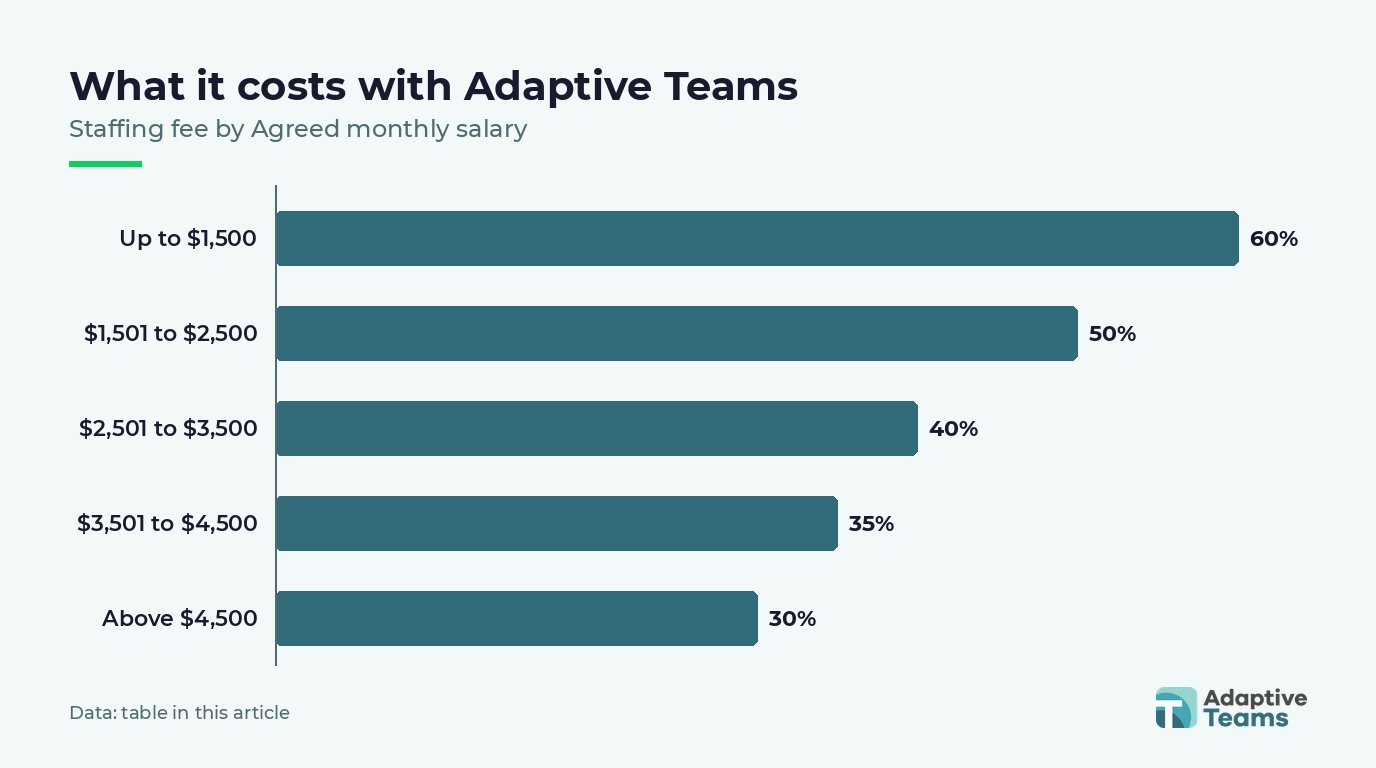
Our staffing fee is a percentage of the agreed monthly salary, and recruitment is included. There is no upfront placement fee: you pay nothing until your new team member starts.
| Agreed monthly salary | Staffing fee | Example |
|---|---|---|
| Up to $1,500 | 60% | $900 on a $1,500 salary |
| $1,501 to $2,500 | 50% | $1,000 on a $2,000 salary |
| $2,501 to $3,500 | 40% | $1,200 on a $3,000 salary |
| $3,501 to $4,500 | 35% | $1,400 on a $4,000 salary |
| Above $4,500 | 30% | $1,500 on a $5,000 salary |
Compare that with a platform on equal terms. On Deel or Remote, a $599 EOR fee buys the legal employment of someone you found yourself. Our fee buys the search, the employment through Deel, HR and a manager who runs reviews. If you have no recruiter and no time to manage a remote hire, the second line is the one to price.
Can I use Adaptive Teams only to find the person?
Yes. Recruitment only costs $4,000 flat per hire, and you employ them yourself. That route works well if you already run Deel or another platform and only lack the search.
The same screening applies: role scoping, skills tests and interviews, then a shortlist of 3 to 5 people. You add the hire to your own payroll setup afterwards.
When Deel is still the better pick
Stay with Deel, or a platform like it, if these points describe you:
- You have an in-house recruiter or a strong referral network that fills seats on its own.
- Your managers already run one-on-ones and reviews for remote staff.
- You need a legal employer in a country where you have no entity and no hiring gap.
- You pay many contractors for short projects and mostly need invoicing.
In those cases our fee would pay for work you already do well. The platform price per worker is lower, and that is the right comparison.
If your shortlist also includes freelance marketplaces, our page on Upwork alternatives compares those against a dedicated hire.
How to choose in one afternoon
Start with the person, then pick the paperwork. Four questions settle most cases:
- Do you already have the candidate? If yes, a platform or your own entity is enough.
- Will the role last longer than a year? If yes, plan for employment.
- Who will run onboarding and reviews? If nobody has the time, budget for a staffing partner.
- How many people will you have in that country? A large, lasting team there can justify your own entity and local advisers.
Write the answers down before any sales call. They keep every vendor, including us, honest about what you are buying.
Frequently asked questions
What are the main Deel alternatives?
The main options are other EOR platforms such as Remote and Oyster, contractor payment tools, your own legal entity, and managed staffing partners. Platforms handle employment for a person you found. A staffing partner like Adaptive Teams also recruits, onboards and manages the hire, while still running payroll through a platform such as Deel.
Is there a cheaper alternative to Deel for employer of record?
Not by much at the starting price. Remote lists EOR from $599 a month on annual contracts, the same as Deel, and Oyster lists $699. Real quotes change with country and benefits, so compare one named country and salary. Contractor management is cheaper elsewhere: $29 a month on Remote and Oyster against $49 on Deel.
Is Adaptive Teams a replacement for Deel?
Adaptive Teams works on top of Deel. Our contracts and payroll run on Deel, and we add recruitment, HR and performance management. You get one invoice per person, a staffing fee as a percentage of salary, and a free replacement if a hire fails, at any point.
Can I cancel a staffing agreement with Adaptive Teams?
Yes. Our contracts run month to month with 30 days written notice on either side, and there is no annual lock-in. Every placement starts with a 2-month probation period, so fit is proven on real work. If the placement does not work out in that time or later, we replace the person at no extra cost.
Should I hire a remote worker as a contractor or an employee?
It depends on how the person works. The IRS looks at behavioral control, financial control and the type of relationship, and an open-ended role points toward employment. A full-time hire with your hours, tools and no end date is usually an employee. Adaptive Teams offers both models and helps you pick per role.
Where to start
If you want the search, the contract and the management handled in one place, book a free staffing consultation and we will map the role, the salary band and a shortlist plan with you.

Written by the people who recruit, pay and manage remote teams every day, with Nate Ginsburg and Menno Gottmer. About Adaptive Teams